
The Internet phenomenon called 'Zeitgeist - The Movie' is one of the most popular hits for Google video, and rightfully so. The movie's near-scandalous expose of the "astrotheological" basis of Christianity has placed many Christian apologists into an understandably uproarious state. The movie goes to great lengths especially demonstrating that the birth narrative of Jesus of Nazareth is purely an allegory for astrological occurrences that took place during the purported time of his birth.
Disclaimer
Before I begin let me state categorically that I am not a Christian. I believe that evidence shows that many Greco-Roman pagan practices have become a part of the Christian tradition which has distanced it from earlier Judaic belief, and this has been documented profusely by many authors and scholars. The consensus seems to be that this fusion was propounded most by the man called Saul of Tarsus, or more commonly recognized as "the Apostle Paul" to Christian audiences, in an effort to more easily convert peoples from a non-Judaic background into a new syncretic faith. Provided the record of Saul of Tarsus is historically accurate in the writings of the Greek Testament, Christianity owes its form to him. Enough said!
What is the purpose of this page?
Simply stated, I prefer honesty in polemics. Some of the astronomical and astrological claims of Zeitgeist are simply wrong, and lead to a wrong impression of the origins of Jesus' birth narrative. I hope to demonstrate scientifically why they're wrong, and to question the agenda of the maker of this movie in drawing these erroneous parallels.
Methodology
The information in this page can be easily confirmed by consulting any astronomical model capable of looking at past and future celestial patterns. I personally use and recommend Starry Night. As I address each issue, I will make every effort to refer as closely to the exact time that the claim is made in the movie, and try to quote the narrative exactly. I have not included screen shots of the movie in order to avoid potential legal issues - please click the link above if you wish to watch the film.
So let's begin!
(Quick jumps: Claim 1 Claim 2 Claim 3 Claim 4 By the way Feedback)
Claim #1
At movie time 20:05, the following statement is made:
"The star in the East is Sirius, the brightest star in the night sky which, on December 24th aligns with the three brightest stars in Orion's Belt. These three stars in Orion's Belt are called today what they were called in ancient times: 'The Three Kings'".
Regarding Sirius being the star in the east, the film is correct. On December 24th Sirius does indeed come above the horizon just after sunset when viewed from Jerusalem. The first question one might ask is what year I'm using as a reference point. The answer is simple - it doesn't matter. Sirius always comes over the horizon in the south-southeastern sky just after sunset on December 24th. In fact, Sirius appears in the eastern sky after sunset in November and in January as well. Are we expected to believe that somehow the occurrence on December 24th of the exact year of Jesus' purported birthday is astrologically unique? Hardly.
One would understandably ask next about the alignment with the three brightest stars on Orion's Belt, and the answer is simple - Sirius always aligns with Orion's Belt. Although constellations move through the sky relative to our view, they do not move relative to each other. It doesn't matter what day of what month of what year - Sirius will always align with the three stars of Orion's Belt. Constellations may change as to when they appear in the sky over time - for example with December 24th, in 2008BCE Orion and Sirius aren't both visible in the night sky until around 5:45pm, and not until 7:24pm in 2008CE. This skewing of the hour of appearance is due to planetary precession, but the point is clear:
Sirius always aligns with Orion's Belt, and has appeared in the eastern sky on December 24th for over 4000 years.
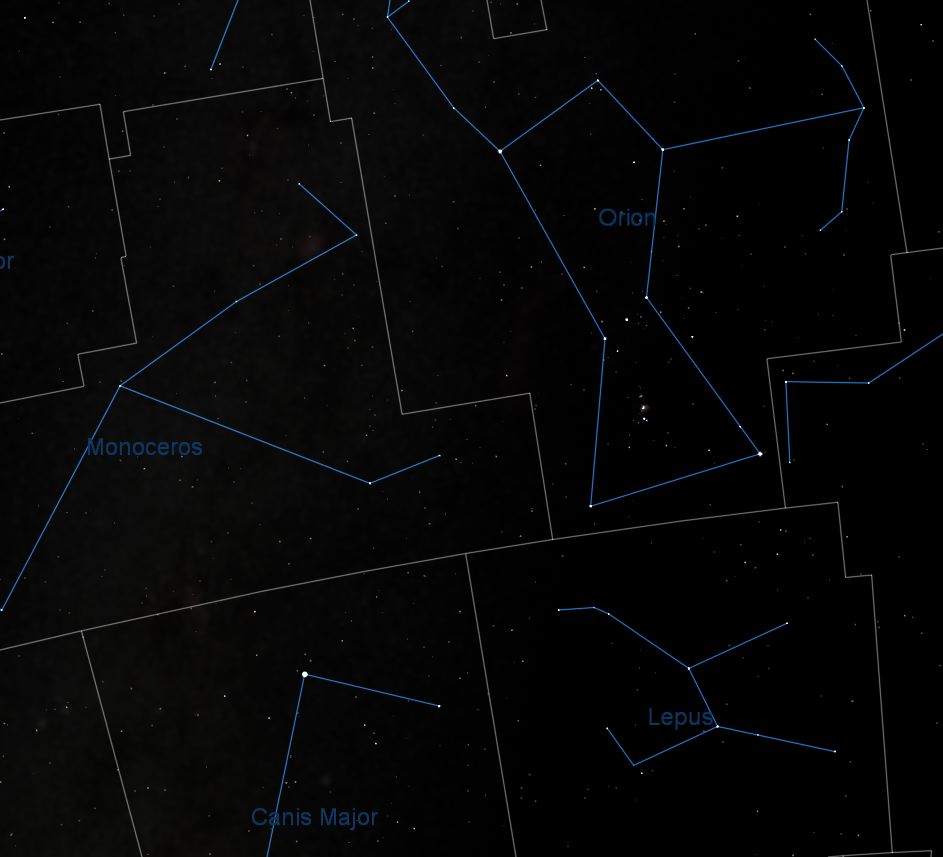
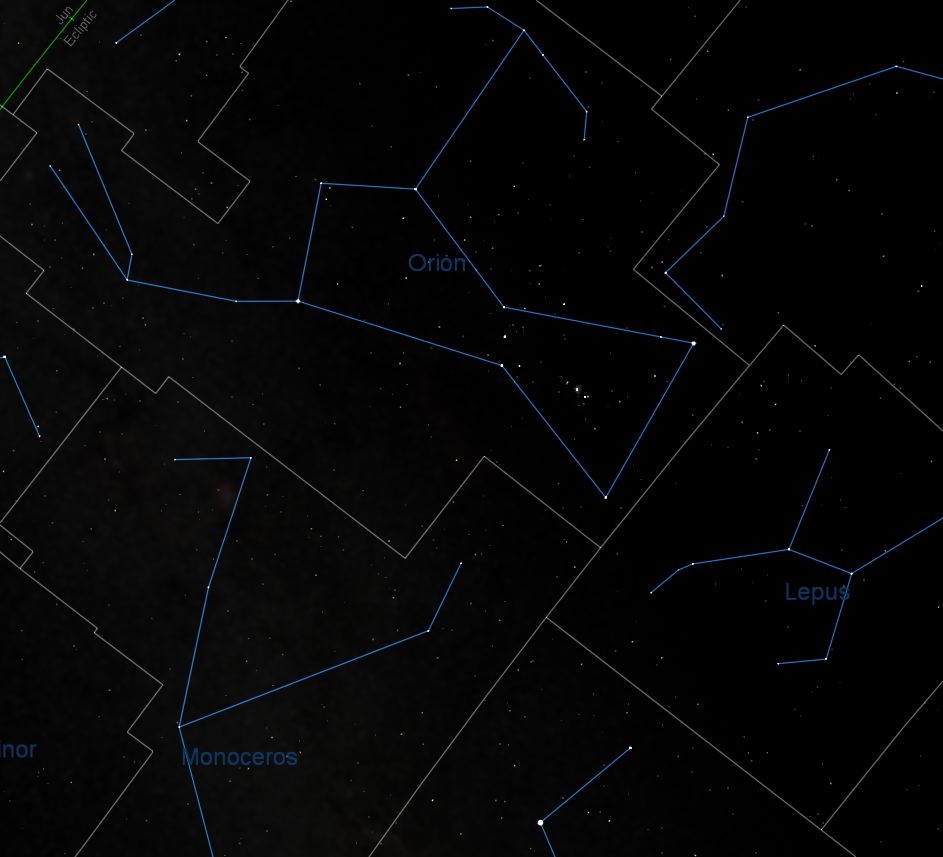
Sirius and Orion's Belt aligning in 2008BCE (above left) and 2008CE (above right).
Indeed, the three stars in Orion's Belt are called "The Three Kings". I have been unable however to find a reference to these three stars as "The Three Kings" in anything older than the 17th century, suggesting that perhaps these stars were so named more than one thousand years after the writing of the Greek Testament in deference to this well-known story.
Claim #2
At movie time 20:20 the following statement is made:
"And the Three Kings, and the brightest star Sirius, all point to the place of the sunrise on December 25th. This is why The Three Kings follow the Star in the East - in order to locate the sunrise - the birth of the sun."
There are two issues with this claim, the first of which concerns the rising of stars above the horizon. On December 25th of any year, Orion and Sirius are not in the sky until after sunset. This is not to say that perhaps Sirius and Orion are actually there in the morning during sunrise and thus simply invisible to the human eye. It is to say that these stars simply do not come above the eastern horizon until after sunset.
By way of example, on December 25th of the year 4BCE (a common estimation of scholars of the year of Jesus' birth), Sirius doesn't appear above the horizon until around 6pm local time (depending on obstructions on the horizon). This fact does not change over thousands of years - Orion and Sirius simply are never in the Eastern sky during sunrise on December 25th from Jerusalem.
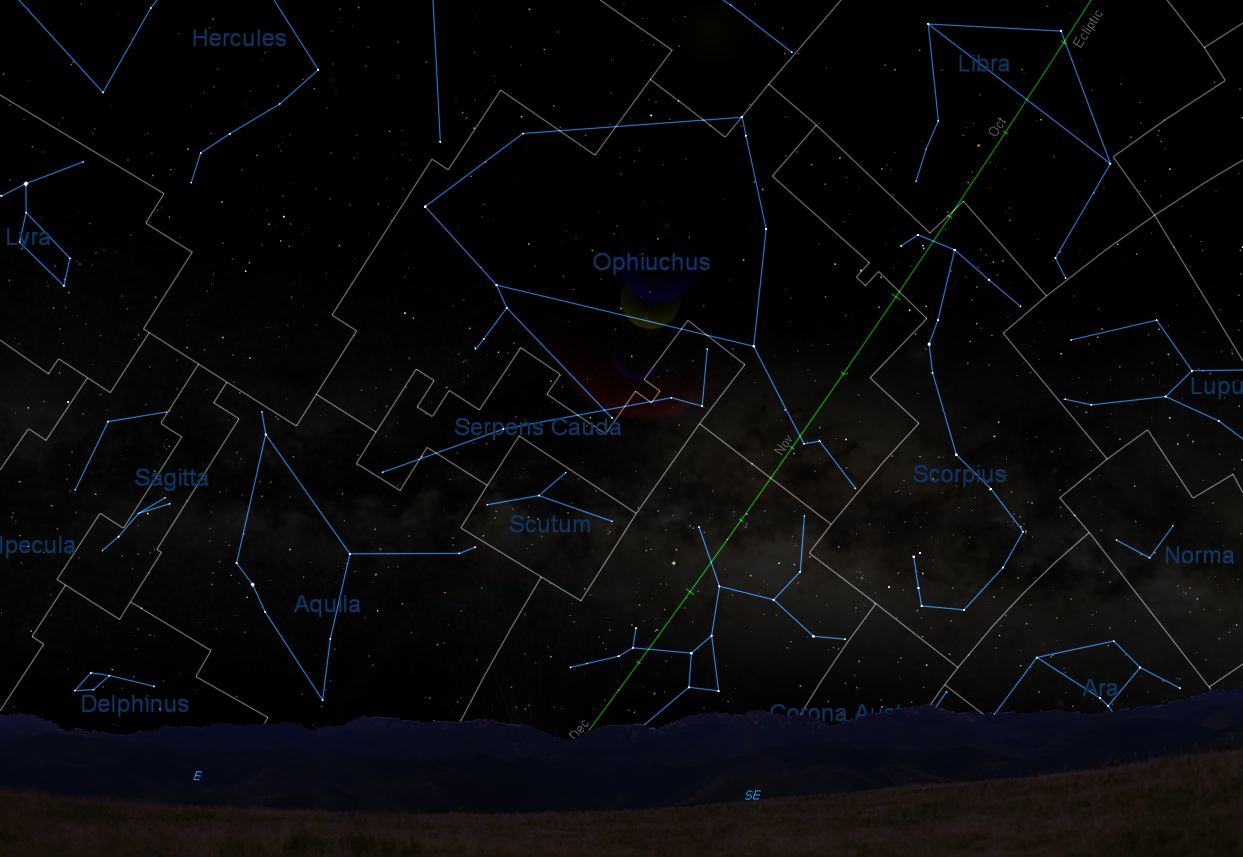
The sunrise sky on December 25th 4BCE from
Jerusalem
The sun travels a line known as the Ecliptic (which is visible as a green line in the picture above). Whether the sun is rising, setting, or making its path through the daytime sky, it never leaves the Ecliptic. If you draw a line through Orion's Belt and through Sirius (particularly as shown in this segment of the movie), you will find that your line will never intercept the Ecliptic. This is to say that Orion's Belt and Sirius can never point to the sun's path of travel.
This brings us to the second issue - the author(s) of Zeitgeist are implying that during the night sky on December 24th, Orion's Belt and Sirius point to the location of the sunrise the next day on December 25th. The answer to this claim is that it does indeed - along with a great many other points on the horizon. In fact, when Orion and Sirius first appear in the sky, the line through them falls almost exactly on the East-Southeast mark (or roughly 112 degrees on the compass, which is not where the sun will rise on December 25th). As the night continues, this line sweeps all across the eastern and southern horizon. By 9:30pm on December 24th (not even 5 hours after sunset), the line has already swept across the compass from around 112 degrees to around 135 degrees. This argument is astronomically meaningless
Claim #3
At movie time 22:01, the following claim is made:
"And during this three day pause, the sun resides in the vicinity of the Southern Cross, or Crux, constellation."
This unfortunately is completely untrue. Recall that earlier we identified the fact that the sun follows a line known as the ecliptic. This never changes - the sun always follows this ecliptic. Examine the pictures below, which show a view of the position of the ecliptic on December 22nd in both 2008BCE and 2008CE from Jerusalem:
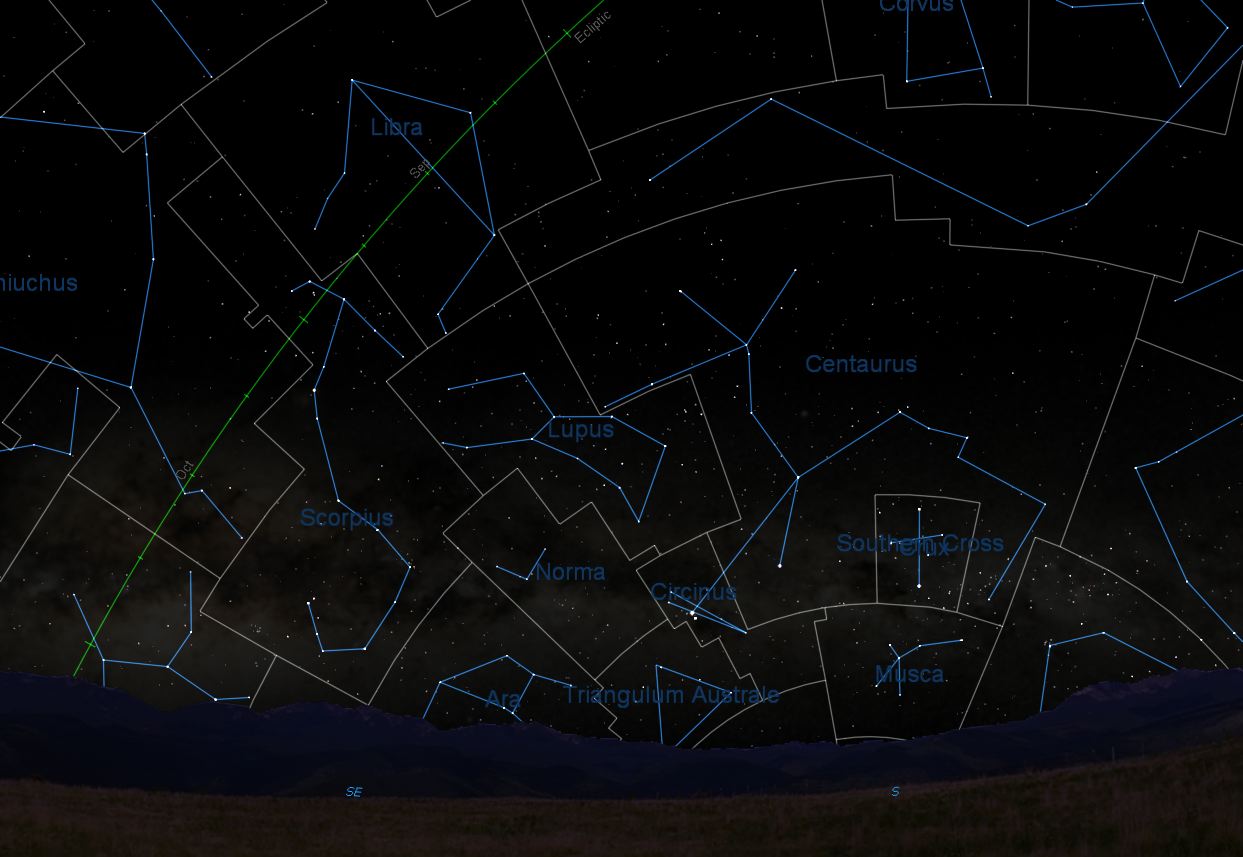
The Crux in the southern Jerusalem sky, 2008BCE
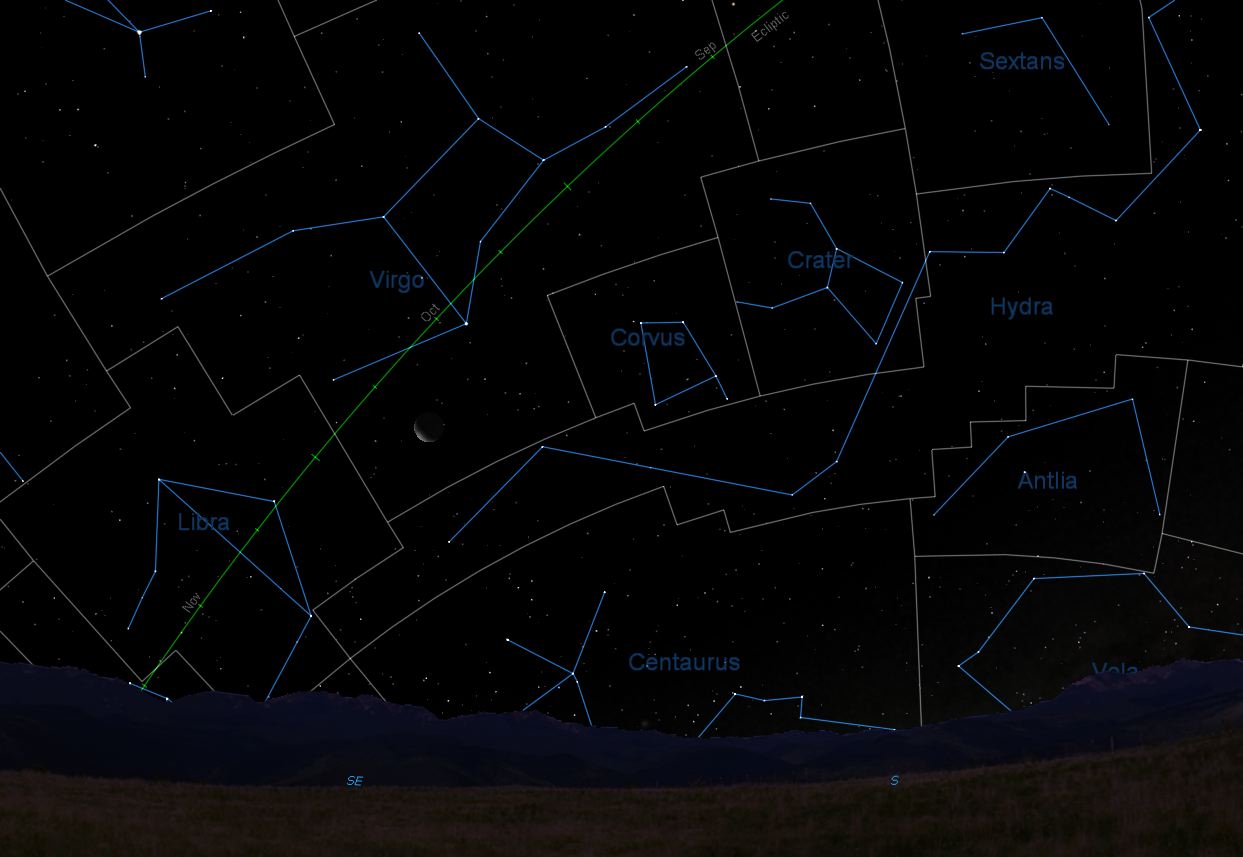
The Crux is not present in the southern Jerusalem sky due to planetary precession in 2008CE
The point to note regards the location of the ecliptic - it NEVER is in the vicinity of the Southern Cross/Crux. In fact, all through December of 2008BCE the sun is in the vicinity of the constellation Capricornus. Four thousand years later, the sun is in the vicinity of Saggitarius. Essentially our planet would have to either turn nearly on its side or fall more than 40 degrees out of orbit in order for the sun to ever reside in the vicinity of the Southern Cross.
Claim #4
At movie time 21:45, the following is stated:
"And by December 22nd the sun's demise was fully realized, for the sun having moved south continually for six months makes it to its lowest point in the sky. Here a curious thing occurs. The sun stops moving south, at least perceivably, for three days [caption of "December 22nd, 23rd 24th"]."
The logic here is terribly flawed. It is scientifically observable that the earth follows an elliptical orbit around the sun, as pictured below:
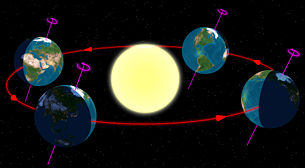
The winter solstice happens for the northern hemisphere when the earth reaches the farthest point in the ellipse (technically known as the end of the major axis) from the sun, with the north pole tilted away from the sun. By contrast, the summer solstice occurs at the opposite end of the ellipse (the opposite end of the major axis) when the north pole is pointing toward the sun. The initial problem is that the earth does not follow our calendar - the winter solstice can occur anywhere from December 20th to December 23rd (source) depending on your location. By way of example, the winter solstice for the year 2008 is on December 21st at 12:04pm GMT, but was on December 22nd at 6:08am GMT in 2007.
For the sake of simplicity however, let us say that the sun always hits its lowest point in the sky, and thus the winter solstice, on December 22nd. The movie states that a "curious thing" happens in that the sun perceivably stops moving for three days, namely December 22nd, 23rd and 24th. If December 22nd is when the earth reaches the end of the major axis of the ellipse that marks the winter solstice, and the continued movement of the earth along the ellipse is perceivably so small that the sun appears to "stop moving" on the 22nd, 23rd and 24th, then it would also seem to stop moving on December 20th and 21st as well. Therefore, by the logic of the movie's creator at movie time 22:20, the Jesus death/resurrection should have been a 5-day event, not three.
And by the way...
At movie time 15:44, the following caption is showed under a picture of the sun:
"GOD'S SUN"
The sun, in moving about the Zodiac, is referred to as God's Sun.
It is later followed by a parallel drawn between "God's Sun" and "God's Son" from movie time 20:29 to 20:42
Although this last item is not directly related to astronomy and astrology, it does regard the sun - specifically the word "sun". The implication (not a claim, an implication) is that the term "God's Son" is merely a small shift from "God's Sun", and thus is shown yet another astronomical parallel. The problem is that using a homophone in the English language to draw this parallel is "spin" at best. Here is a comparison of the phonetic pronunciations of these two words.
English Son Sun
Hebrew Ben Shemesh (or hammah)
Greek Gios Ilios
Egyptian Sa Ra
Contrary to the viewpoint of ignorant individuals or groups, King James did not write the Bible in English. The collection of books known by Christians as "the Bible" were written in Hebrew, Aramaic and Greek. Any implication based on the English language is spurious.
In Closing
As one begins to ask questions that are deemed taboo by culture at-large, it is important that all sides of such inevitably ensuing dialogue are open and honest. Comparative or polemical discussion cannot take place when one side or the other is dishonest about the facts they bring to the table. Although there is factual astronomical and astrological information in the first part of Zeitgeist, those claims made by the movie that have been addressed above are either mistaken (and thus present an argument from ignorance) or are deliberately deceptive (or what some might call 'a lie').
==============================================================
Care to leave feedback? Click here and scroll down to the "Comments" section.
==============================================================
Past Feedback
From Ben in Exeter, United Kingdom:
"I recently watched the movie Zeitgeist and was impressed by the succinctness and clarity of its argument. I must admit that initially I was taken in by its articulate interpretation of cross-religion Sun Gods as an allegory of astrological happenings. But after some time, when I had a chance to remove my self from the impressive production values and well paced narrative, I began to reconsider the accuracy of many statements made in the first part of the film.
Although my gut was telling me that parts of the film's explanation were contrived and manipulated to suit the intentions of the authors, I lacked the astrological nous to know for sure. Reading your critique shed a lot of light on the matter for me (especially the inclusion of the simulation software Starry Night). So thank you very much for taking the time to research it.
I still think there is something to be said for the similarities between Christianity and the preceding Pegan and Eastern religions, which possibly indicates a common origin for the concept of religion. However, I think it was irresponsible of the film's makers to go to such lengths to contrive evidence to support their argument. I think it would be a much more powerful film had it restrained from such manipulation of facts and simply presented the evidence for multi-religion similarities.
Many thanks for providing the facts on a topic that has been bugging me for a while now.
Finally, respect where respect is due: Zeitgeist certainly encourages discussion of taboo subjects, which I believe to be very important."
=====
From Doniel in Calgary, Canada:
"Just a thought, i'm not necessarily disagreeing with the above, but your dismantling of the claims pertaining to the birth of Christ story references, in a number of places, the view of the sky from Jerusalem. I'm wondering why you chose this location and if the claims made in the Zeitgeist Movie might be more likely to be true if viewed from Central America (i'm just thinking about early mayan cultures and their view of the stars on Dec 24)?"
Response:
"First and foremost, thank you very much for your feedback! I'm grateful that you've taken the time to write.
The view of the sky has been taken from Jerusalem due to the fact that Christianity claims that Jesus was born in the vicinity of this city. Since this part of the world is the claimed origin of the Christian religion, I have chosen to reflect those views of the sky.
That said, I also understand your question concerning Central America, and in particular the Mayan civilization. Modern archeology has shown that the Mayan civilization was highly advanced astronomically and astrologically, having a highly defined calendar system.
The answer to your question, at the risk of sounding glib, is that we're all on the same rock. The only claim that would be affected by viewing the sky from Chichen Itza as opposed to Jerusalem is 'Claim #3'. Because you are now viewing the sky from south of the Equator, the Southern Cross appears higher in the sky. But the Ecliptic is also higher in the sky! The sun will "stay" in the same constellation regardless where you view the sky in the world.
All other claims cited remain unaffected regardless where the sky is viewed on our planet."
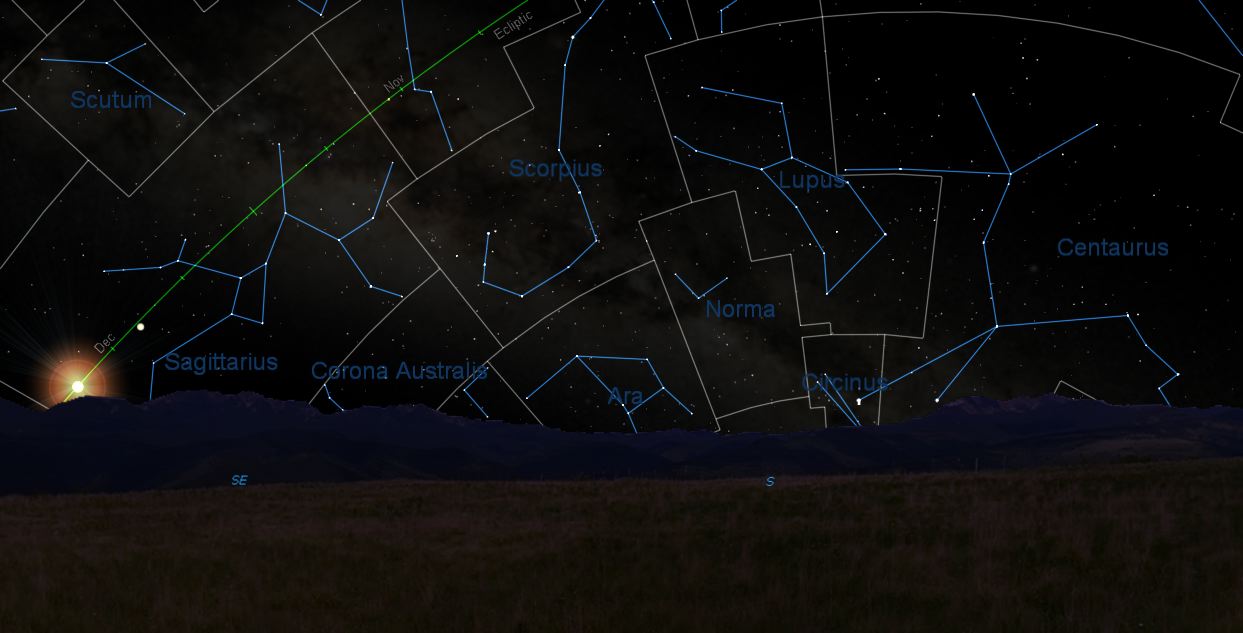
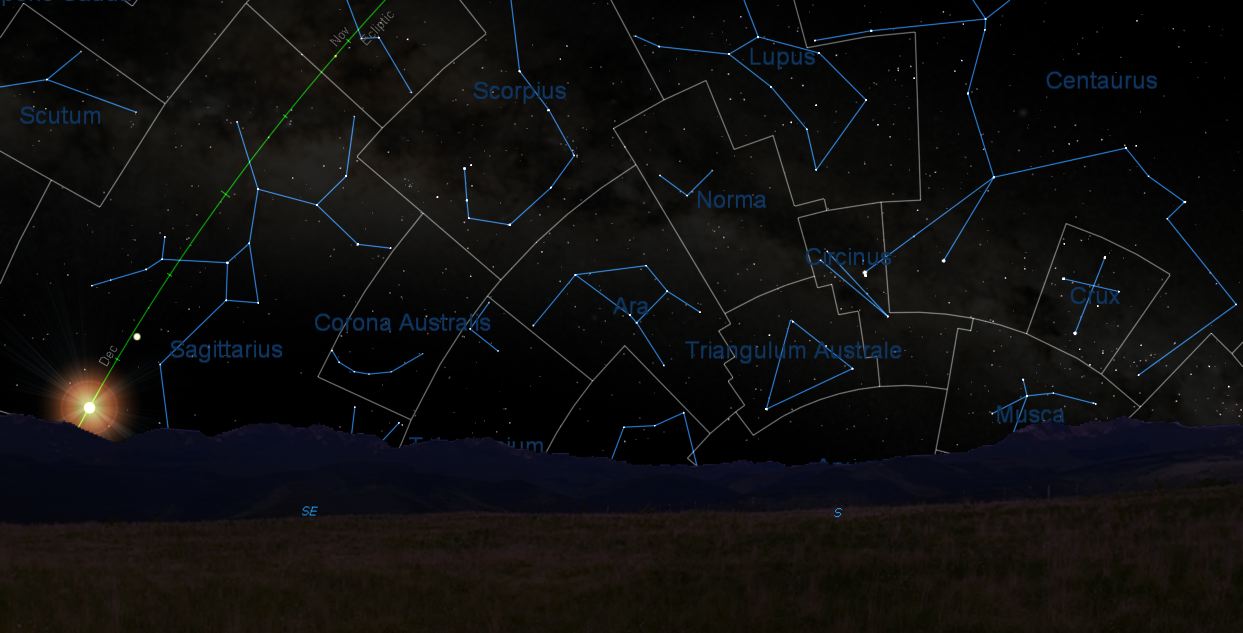
Crux view from Jerusalem (left) and Chichen Itza (right) on December 24th, 1CE. Note that the Southern Cross is not in view from Jerusalem over the horizon (see its border just below Centaurus), whereas its higher in the Chichen Itza sky. Regardless, the Ecliptic is still in the same place relative to the Southern Cross wherever in the world you view it.
=====
From J in Kentucky, USA:
"I appreciate your thorough analysis of the theories in the Zeitgeist movie. I question however why you use Jerusalem as the point of reference instead of Egypt and whether this would change any of your results. "
Response (not via email, as no address supplied):
"Jerusalem was used as this is the generally-accepted nearest 'big city' to the claimed birthplace of Jesus of Nazareth. As per the feedback post listed above concerning Chichen Itza, the only change that viewing from Egypt would provide relates to the Southern Cross and its relative height in the sky."
=====
From Mary in Oklahoma City, OK, USA:
"Thank you, Bill, so very much for your objective research. My thoughts on this were so very adequately expressed by Ben in Exeter, United Kingdom. Over and above it all, I understand claims of Jesus' birth are that he was not born on December 25th as myth would state, but sometime in the early fall...maybe October. Thank you, again."
Response (not via email, as no address supplied):
"Mary, I'm so pleased that you found the page to be enlightening. Regardless what faith dictates, my objective was to show that the myths put forth by the first Zeitgeist movie were simply dishonest. Although I'm not a Christian myself, I do hope that Christians take heart from my work and use this information to combat the intellectual dishonesty that some people use against Christianity.
I have been reading the book 'The Christ Conspiracy: The Greatest Story Ever Sold' by Acharya S. The intellectual dishonesty literally drips from the book. I came across one such error, and was so compelled to respond that I put an entry in my blog (click here). Perhaps I will do a similar page to this regarding this book."
=====
The next feedback item will pertain to ancient Sumeria, and whether there would be any difference to this situation viewed from there. Stay tuned!
Back to Virtual Bill's page